
Preparing an App Development Brief: From an Idea to a Clear Scope
Start an app development conversation without a finished specification. Define users, the core task, first-release scope, references, and open questions in a practical one-page brief.
You can start discussing an app before its specification is complete. Focus first on the people using it, the problem they face, and the task the first release must let them finish. This guide separates an initial conversation brief from the scope that needs agreement before development.
1 Describe the person and the problem first
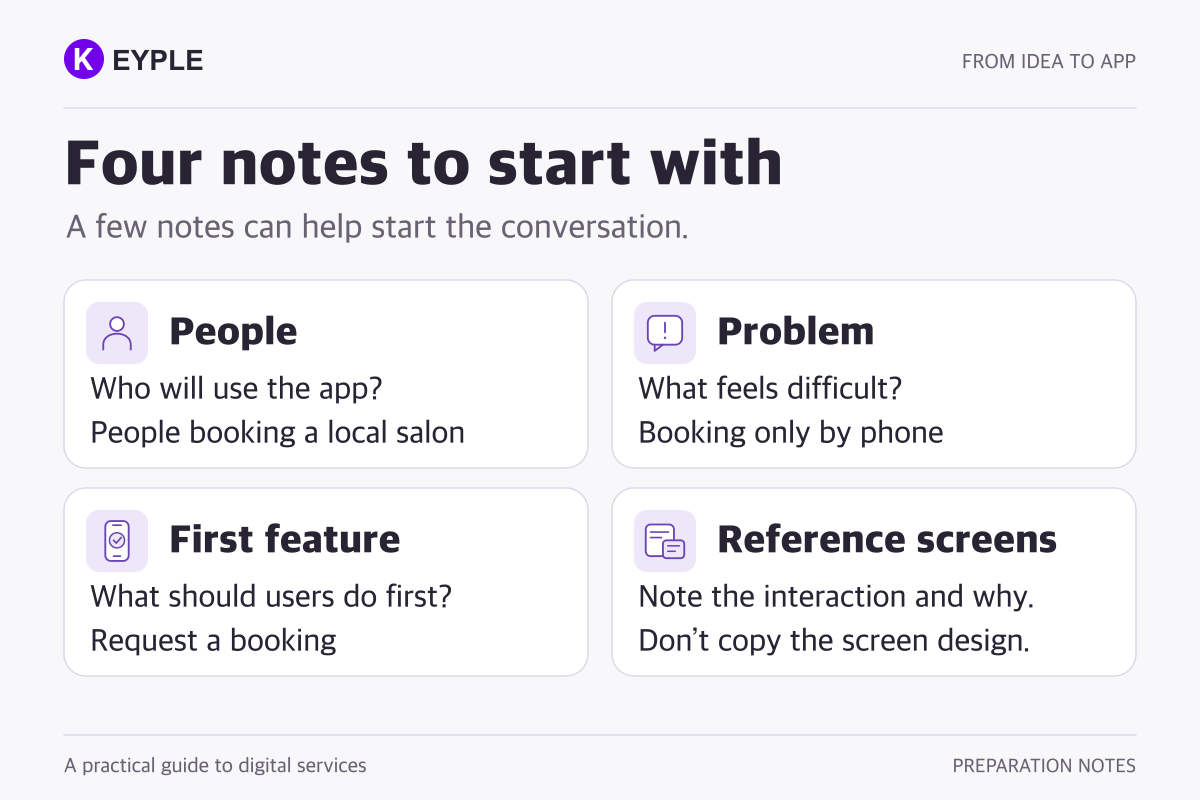
You can begin a development conversation without a polished specification. However, “I want a booking app” does not tell a developer enough to define the work. Start with who needs it, how they handle the task today, and what gets in their way.
Consider a small hair salon that wants to improve bookings. This is a hypothetical example, not a client case study.
- User: An existing customer trying to book their next visit outside opening hours.
- Current method: They call or message the salon to ask about availability.
- Problem: The customer waits for a reply, while staff repeatedly answer scheduling questions during appointments.
- Desired outcome: The customer checks available times, requests a booking, and can see whether it is confirmed.
Separate things customers have actually said from assumptions you have not checked. Looking at the current process or asking a few customers may change which problem deserves attention first. The GOV.UK guide to understanding user needs starts with users, their current methods, and the difficulties they experience.
2 Follow one task from beginning to end
A list such as “sign-up, bookings, payments, notifications” leaves considerable room for interpretation. For an initial discussion, describe one important task as a sequence.
- The customer chooses a treatment.
- They check available dates and times.
- They provide the required contact information and request a booking.
- The salon confirms the request or proposes a change.
- The customer checks the booking status.
This reveals decisions that a screen list misses. Are bookings confirmed immediately or after a staff review? What happens when two people request the same slot? Can customers cancel in the service, or must they contact the salon?
You do not need every answer before making contact. Unanswered questions are useful preparation, provided they are resolved for the work being commissioned before implementation begins.
Define completion through observable outcomes. “A confirmation screen appears” is less specific than “the customer and the salon see the same confirmed time, and an unavailable slot cannot receive another confirmed booking.” The GOV.UK guide to user stories explains how user goals and acceptance criteria help establish whether a task is complete.
3 Separate the first release from later ideas
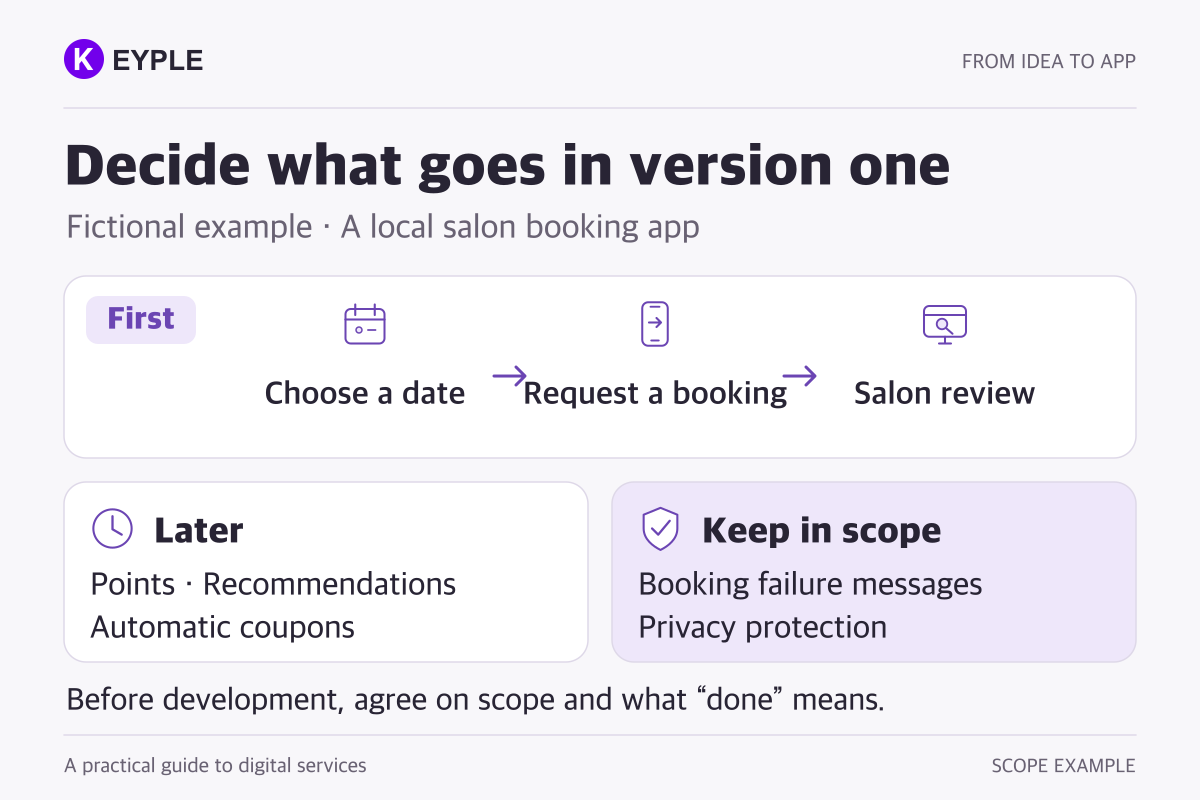
Loyalty points, recommendations, and automatic coupons may all sound appealing. Ask whether the user can complete the chosen task without each feature.
For the hypothetical salon, the initial scope might focus on availability, booking requests, staff decisions, and customer status checks. Loyalty points, recommendations, and automatic coupons could be considered later. If deposits are essential to the salon’s operation, however, payments cannot simply be postponed. Similar services can need different first releases.
Cut optional features, not the safeguards necessary for the selected workflow. Relevant privacy measures, access control, duplicate-booking handling, and failure messages still belong in the discussion. Note any work staff must handle manually when a feature is excluded.
Once the core task is clear, the MVP scope and timeline guide can help you think about release stages.
4 Annotate references instead of asking for a copy
Reference apps and websites help explain preferences. “Make it exactly like this” leaves unclear whether the request includes hidden administration, integrations, and data processing.
Be specific about the part you like and why.
- “I like how this booking screen shows only available times.”
- “This color palette works for us, but we want a simpler registration process.”
- “This service introduction is easy to understand. We do not need its checkout.”
A paper sketch or short note can be enough to start. You do not need finished designs in a professional tool. References explain intent; they do not give permission to reuse another service’s images, copy, or branding.
List any logo, content, website, or booking tool you already have and who manages it. Use sample information in discussion materials. There is no need to include customer records or account passwords.
5 Distinguish constraints from open questions
If the budget or launch date is undecided, say so instead of inventing a number. State any known limitations so that implementation options can be compared.
- Platforms: Are both iPhone and Android apps required, or could a mobile website be considered first?
- Timing: Is there a fixed event, a preferred date, or room to adjust?
- Budget: Is there a ceiling, a working range, or no allocation yet?
- Operations: Who will process bookings and answer customer questions?
- Existing tools: Which website, booking system, or payment provider should be considered? Has integration support been checked?
- Materials: Which brand assets, content, designs, and store accounts are ready, and which still need preparation?
Treat “we can connect the existing booking tool” as an assumption until its integration options and terms have been checked. If the platform choice is open, explain your preference and its reason, then compare approaches during the discussion.
6 Bring a one-page brief to the conversation
Copy these prompts and fill in what you know. Shared understanding matters more than a polished layout.
- The service I want to build:
- The first people who will use it:
- Their current problem and how they handle it today:
- One task they need to complete:
- Features needed for the first release:
- Ideas that can be considered later:
- References and the specific parts I like:
- Budget, timing, and platform constraints:
- Available materials and the person responsible for operations:
- Questions that are still open:
This brief starts a discussion; it does not replace a specification or agreement. Before confirming a quote and the scope of work, clarify inclusions and exclusions, responsibilities for designs and content, integrations, acceptance criteria, and how changes will be handled. If you receive an initial estimate, ask which assumptions it relies on.
Planning support and any separate fee vary by provider and project. Being able to start without a specification does not mean all planning work is free. Agree who will prepare what. When comparing proposals, see the app development quotation guide.
KEYPLE’s Flutter app development service includes discussing how an idea can become a practical first release. Explore the portfolio, then share what you know and the questions you are still working through. You can start with a clear problem before you have a finished specification.
Frequently asked questions
Can I contact a developer without a specification?
Yes. A short explanation of the users, their problem, references, and your current preparation can start the conversation. Before confirming a quote and implementation scope, agree on the included work, exclusions, and acceptance criteria.
Do I need to design every screen myself?
No. A sketch or annotated reference can help with the initial discussion. Agree who will prepare any detailed requirements, user flows, and designs, and what that work includes.
Can I ask for advice before deciding on a budget or launch date?
Yes. Mark undecided items as open questions. Share any firm budget ceiling or immovable event date, and check which scope and assumptions an initial cost or schedule estimate relies on.
Does starting without a specification mean planning is free?
No. The ability to begin a conversation and the cost of planning are separate. Ask what requirements analysis, screen design, and integration research are needed, who will do them, and whether separate fees apply.