
App development cost and timeline: seven factors to check
Compare iOS and Android app development estimates across features, design, backend, administration, store launch, and a budget-conscious MVP scope.
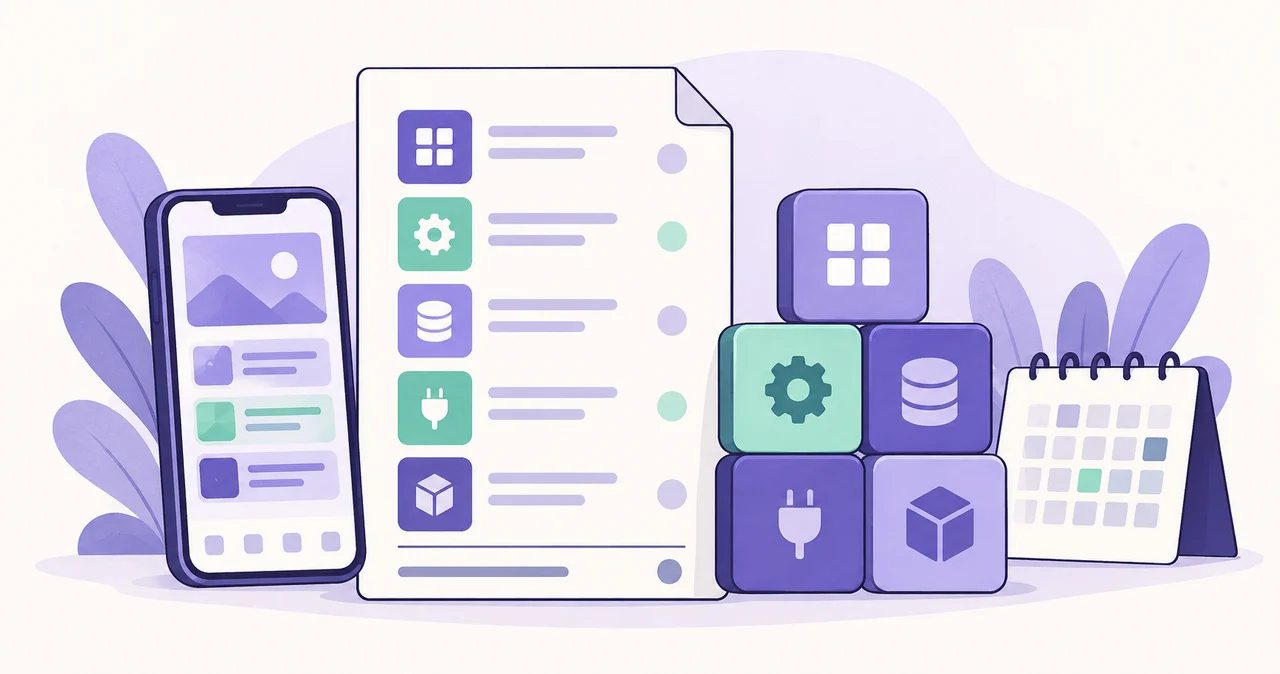
An app development estimate is not determined by screen count alone. Authentication, data processing, payments, notifications, and other integrations can make two visually similar screens very different to build. Clarifying these seven areas reduces hidden assumptions, separates launch essentials from later additions, and produces a more comparable schedule and budget.
1. Define the problem and the core user first
Before listing features, define whose problem the app solves. Journeys and permissions change significantly when a product serves multiple roles, such as customers, operators, and administrators.
For the first release, focus the MVP on one or two actions users absolutely need to complete. Adding every supporting feature before validation can increase cost and schedule before the central assumption has been tested.
2. Review the factors that change an app estimate
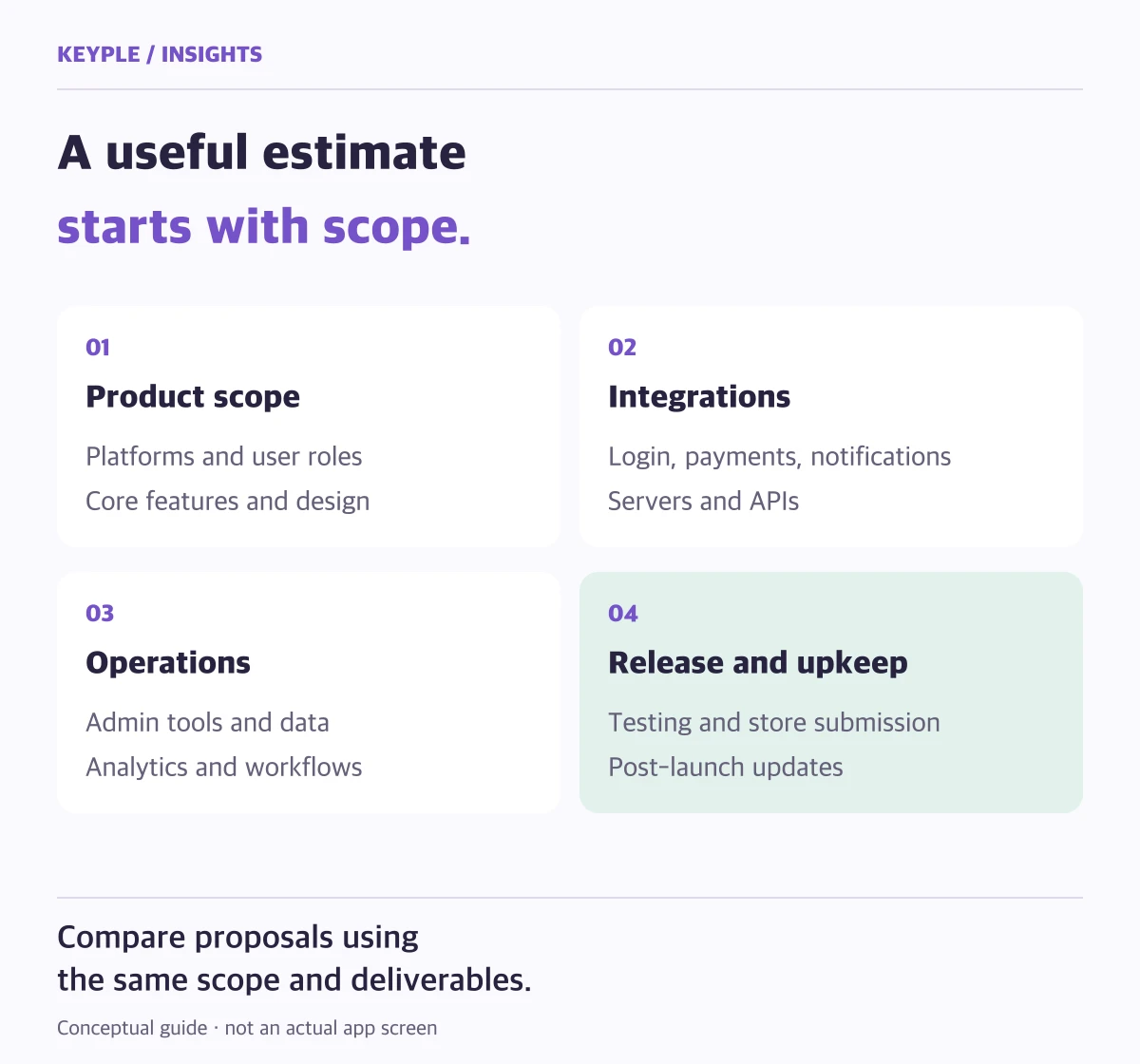
When comparing proposals, look beyond the total and confirm exactly how far each of these areas is included.
- Whether the first release covers both iOS and Android or begins with one platform
- Email or social login, user roles, account management, and permissions
- Payments, subscriptions, push notifications, maps, cameras, and external services
- A new backend and database versus integration with an existing API
- Admin tools, operational dashboards, and analytics
- The readiness of specifications, wireframes, and UI/UX design
- App Store and Google Play submission, review responses, and post-launch maintenance
3. Understand how Flutter affects cost and operation
Flutter makes it possible to develop iOS and Android from one project and maintain consistent features and UI. Platform-specific behavior still requires separate verification, especially for notifications, payments, permissions, and store policies.
Flutter is often efficient when both platforms are required and the interface matters. If a product depends deeply on unique operating-system capabilities, compare that requirement with native development before deciding.
4. Prepare useful material before requesting an estimate
You do not need a finished product document. Reference apps, core users, essential features, a target launch window, and a budget range are enough to make the first conversation much more concrete.
- A one-sentence description of the product
- Primary users and the key action each must complete
- Separate lists for must-have and nice-to-have features
- Reference apps or screenshots
- Existing servers, APIs, brand assets, and designs
- Target launch timing and an operational plan
5. Reduce scope by staging the launch, not by removing validation
A safer way to reduce cost is to narrow the first hypothesis and user journey instead of removing testing. Administrative automation, secondary analytics, and convenience features can begin with a manual workflow and move into a later version after demand is proven.
A useful proposal separates planning, design, development, testing, and launch deliverables. It should also clarify revision rounds, source-code and account ownership, store-review support, defect warranty, and maintenance conditions.
6. Compare providers using the same scope
Totals are not comparable when each provider assumes different features and deliverables. Send one outline covering platforms, user roles, essential journeys, design readiness, backend and administration, launch, and maintenance.
KEYPLE first separates core features and integrations, then proposes a schedule and estimate in units that can reach a real release. A finished specification is not required; reference products, must-have features, and target timing are enough to begin.
7. Include store review and post-launch operation
Development completion and public availability are separate milestones. Confirm who prepares store content, privacy documents, reviewer credentials, rejection fixes, and resubmissions for App Store and Google Play.
After launch, server and third-party costs, incident response, OS and SDK updates, and small product improvements continue. Reviewing the maintenance model with the initial estimate gives a more accurate total operating cost.
Frequently asked questions
Can I receive an estimate without a finished specification?
Yes. We can begin with the product goal, primary users, and essential features, then define an initial scope and phased estimate together.
Does building iOS and Android together take much longer?
Flutter lets us share core features and UI, but payments, permissions, notifications, and store review still need platform-specific validation. The schedule depends on the actual feature scope.
Is maintenance included after launch?
We separate defect warranty, operational monitoring, OS updates, and follow-up feature development according to the project. Confirm the included period and scope before contracting.