
A checklist for choosing an app development partner
Compare app development proposals across scope, source and account ownership, testing, launch support, maintenance, and communication.
Two app development proposals can show the same total while including very different work. Align the depth of product definition and design, backend and admin tools, store launch, defect warranty, and source-code handoff before comparing a price or selecting a partner.
1. Compare the same scope and deliverables
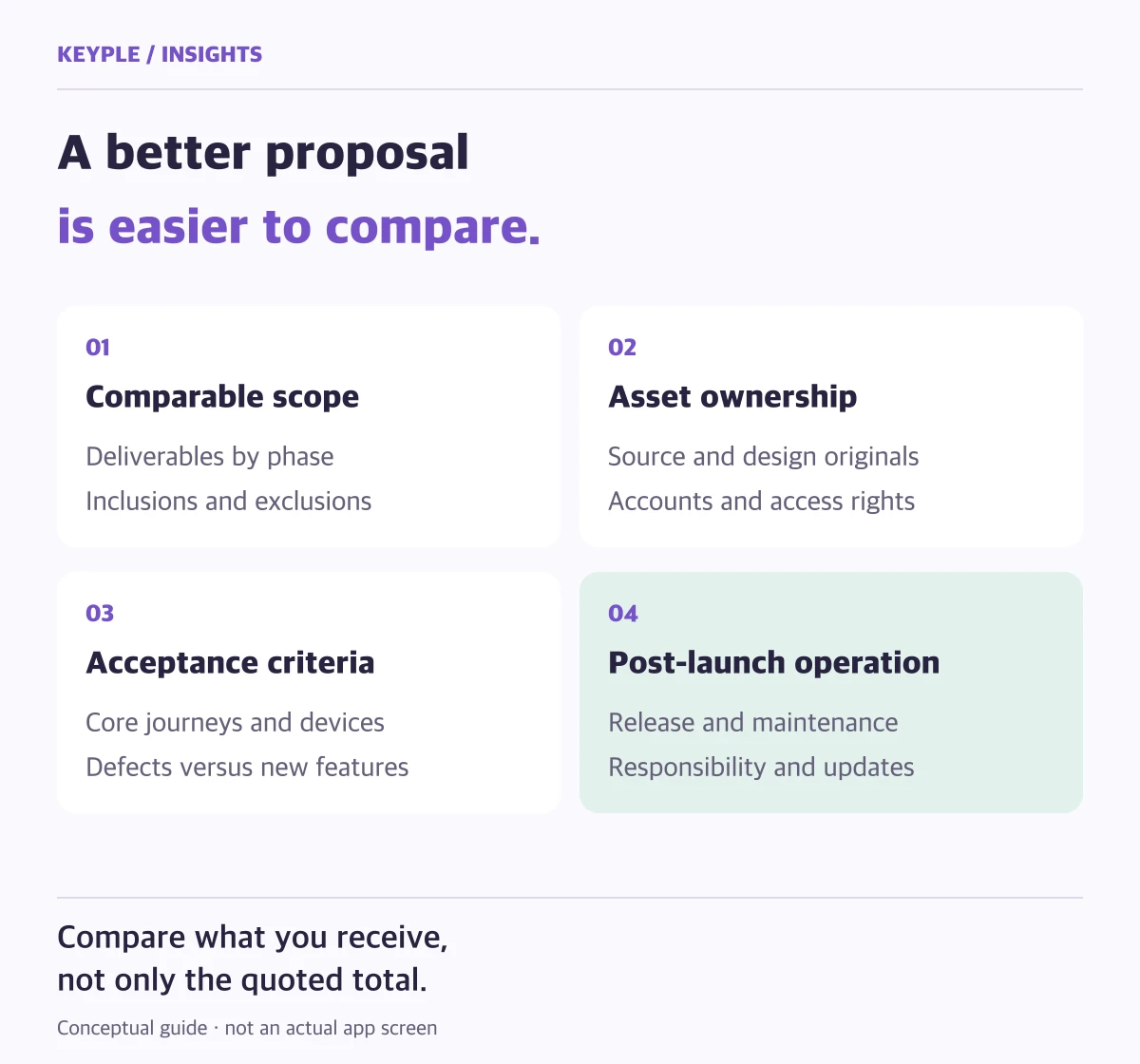
Totals are not comparable when every provider makes different assumptions. Prepare one outline covering supported platforms, user roles, major screens, external integrations, backend and administration, and launch support.
A proposal should expose phase deliverables and exclusions. When it only says ‘complete app development,’ ask whether original design files, API documentation, admin features, and store-review responses are included.
2. Confirm ownership of accounts and deliverables
Where practical, the client should own domains, App Store Connect, Google Play Console, cloud, and analytics accounts, then grant the development partner only the access it needs.
- Handoff of the source repository and its complete commit history
- Original design files and licenses for fonts and images
- Ownership and billing responsibility for servers, databases, and storage
- Store listing details and the management of signing keys
- The contracting party for third-party SDKs and paid services
3. Define testing and acceptance before signing
The phrase ‘testing included’ does not establish a scope. Specify supported OS versions and devices, critical user journeys, network failures, payments and notifications, and any data migration.
Agree on the distinction between a defect and a new feature, the acceptance period, the change-request process, and response expectations for critical issues.
4. Separate launch support from ongoing operation
Development completion and public release are different milestones. Confirm responsibility for store copy and images, privacy documents, review feedback, server deployment, and monitoring.
After the included warranty period, compare monthly maintenance, individual change requests, and follow-up projects, including responsibility for OS and SDK updates.
5. Evaluate communication as a delivery system
A useful proposal explains decisions, risks, and alternatives clearly. Identify the responsible lead, update cadence, progress tools, and the process for approvals and scope changes before work begins.
A partner that asks about unknowns and separates the scope often provides a more operationally realistic plan than one offering an unusually short schedule or an unsupported fixed price.
Frequently asked questions
How many app development proposals should I compare?
Comparable scope matters more than the number of providers. Send the same feature and deliverable outline, then align assumptions, inclusions, and exclusions in a table.
Should the client always receive the source code?
For continued operation and the possibility of involving another team, request the repository, build instructions, and environment setup. State the handoff scope in the contract.
Is choosing the lowest estimate risky?
The price itself is not the issue; missing essential work is. Compare total operating cost across design, backend, testing, launch, and maintenance.